

Keep On Truckin’: Meaning, History & Origins
What does “Keep on Truckin’” mean, and where did it come from? The phrase is an upbeat way to say “keep going” or “carry on,” even when life gets difficult. Its story connects blues music, R. Crumb’s underground comics, and the counterculture of the 1960s and 1970s.
Here, we trace the phrase’s history and its place in popular culture. Looking for a gift inspired by the saying? Browse Keep On Trucking products, including novelty license plates, bumper stickers and hats.
What does Keep on Truckin’ mean today?
Today, “Keep on Truckin’” is a reminder to persevere: take the next step and keep moving forward when things get tough. It works as an encouraging message for a friend or a personal motto. In the slogan, “truckin’” is about carrying on, not just driving a truck.
Where did “Keep on Truckin’” originate?
An early popular-music connection is Blind Boy Fuller’s 1936 song “Truckin’ My Blues Away.” The blues recording predates the cartoon that later helped make the expression a widely recognized slogan.
The phrase’s journey from blues music to counterculture was not a single leap. Underground cartoonist Robert Crumb, also known as R. Crumb, played an important part in bringing it to a new audience.
R. Crumb and the Keep on Truckin’ cartoon
Crumb, a blues enthusiast, used the phrase in a one-page cartoon published in the first issue of Zap Comix. Its exaggerated, striding characters helped turn “Keep on Truckin’” into a recognizable image as well as a saying.

Find a Keep On Trucking gift
Bring the saying into your gift search with our Keep On Trucking collection. For a specific option, view the vanity license plate below and check its product page for current details and availability.
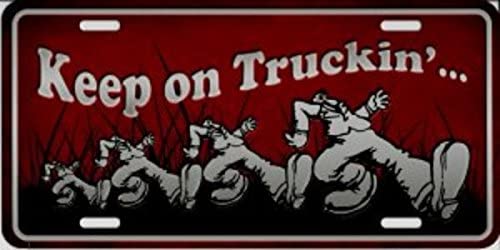
Shop the Keep On Trucking Vanity License Plate
More Keep On Truckin’ product suggestions
Choose a way to carry the keep-going message with you, or find a gift for someone who appreciates the saying.
- Keep On Truckin’ Bumper Sticker: A peel-and-stick option for a car, laptop, water bottle or toolbox. Check the product page for available sizes.
- Keep On Truckin’ Solid Background Vanity License Plates: A 6 × 12-inch aluminum novelty plate with pre-punched mounting holes. Explore the background color options on the product page.
- Keep On Trucking Motorcycle License Plate: A smaller, 7 × 4-inch aluminum plate option. Review its dimensions and product details before choosing.
- Keep On Trucking Hat with Rectangle Patch: A low-profile chino twill hat with a faux-leather patch, pre-curved bill and adjustable buckle closure.
Shop the Keep On Trucking collection to compare styles. Visit each product page for current pricing, options and availability.
A counterculture slogan with a complicated legacy
The cartoon became associated with the counterculture of the 1960s and 1970s, but its popularity brought Crumb unwanted attention. He expressed frustration with being treated as a spokesman for the movement and with the widespread commercial use of his work.
His reaction is part of what makes the phrase’s history interesting: an image embraced as a cheerful message of perseverance became a source of discomfort for its creator.
Filmmaker Terry Zwigoff also discussed Crumb’s reluctance to license the drawing for advertising. The interview linked in the notes offers more context about Crumb’s relationship with the image and its commercial success.
Keep on Truckin’ and the Grateful Dead
The phrase also has a place in discussions of rock music and the Grateful Dead’s “Truckin’.” Bob Weir’s account, linked below, connects the spirit of the song with the saying associated with Crumb’s work.

Keep on Truckin’ or Keep on Trucking?
“Keep on Truckin’” is the informal spelling commonly associated with the cartoon and slogan. “Keep on Trucking” uses the full word and is another way people search for the expression and related gifts. In this context, both point to the same encouraging idea: keep moving forward.
Explore the Keep On Trucking collection to find a reminder of that keep-going spirit.
Sources and further reading
1. Crumb’s interest in early American music is reflected in R. Crumb’s Heroes of Blues, Jazz & Country.
2. Learn about the underground comic’s background: Zap Comix on Wikipedia.
3. Read the interview discussing Crumb and the cartoon’s popularity: “Crumb”: How Comic Kept On Truckin’.
4. The cartoon’s history also includes copyright disputes. Its popularity should not be taken as permission to reproduce the artwork.
5. Read the music connection: Bob Weir Gives Fascinating Backstory on How “Truckin’” Came to Be Thanks to the Dead’s Travels.
You may also like
Explore another phrase with a distinctive history: What does Funkingruven mean, and what are its origins?
- Choosing a selection results in a full page refresh.
- Opens in a new window.